How Celebrity Posts Go Viral Without Breaking Instagram
One post, millions of likes and comments in minutes. How Instagram handles the celebrity problem by keeping unbounded work off the synchronous path.
 Dhananjay Aggarwal, · 5 min read
When a celebrity posts on Instagram, the platform faces one of the harshest real-world load tests there is.
Within minutes, a single post can attract:
- millions of likes
- millions of comments
- millions of reads
From a systems perspective, this is a nightmare scenario. One object suddenly becomes the hottest read key and the hottest write target in the entire system.
If this traffic were handled like a normal post, the database would collapse almost instantly.
In system design, this challenge is known as the Celebrity Problem.
Instagram survives virality by architecturally refusing to perform dangerous operations, instead of scaling blindly.
Let’s break down how.

1. The Celebrity Spike Problem#
Most backend systems are implicitly designed for evenly distributed traffic. Celebrity posts break that assumption immediately.
A naive implementation would:
- read millions of rows to display likes
- synchronously insert millions of comment records
- sort comments live on every request
This leads to:
- hot partitions
- lock contention
- cascading latency failures
Instagram’s first architectural rule is strict:
No synchronous request may touch unbounded data.
If an operation can grow with popularity, it is pushed out of the critical path.
2. Likes Are Not Read as Rows#
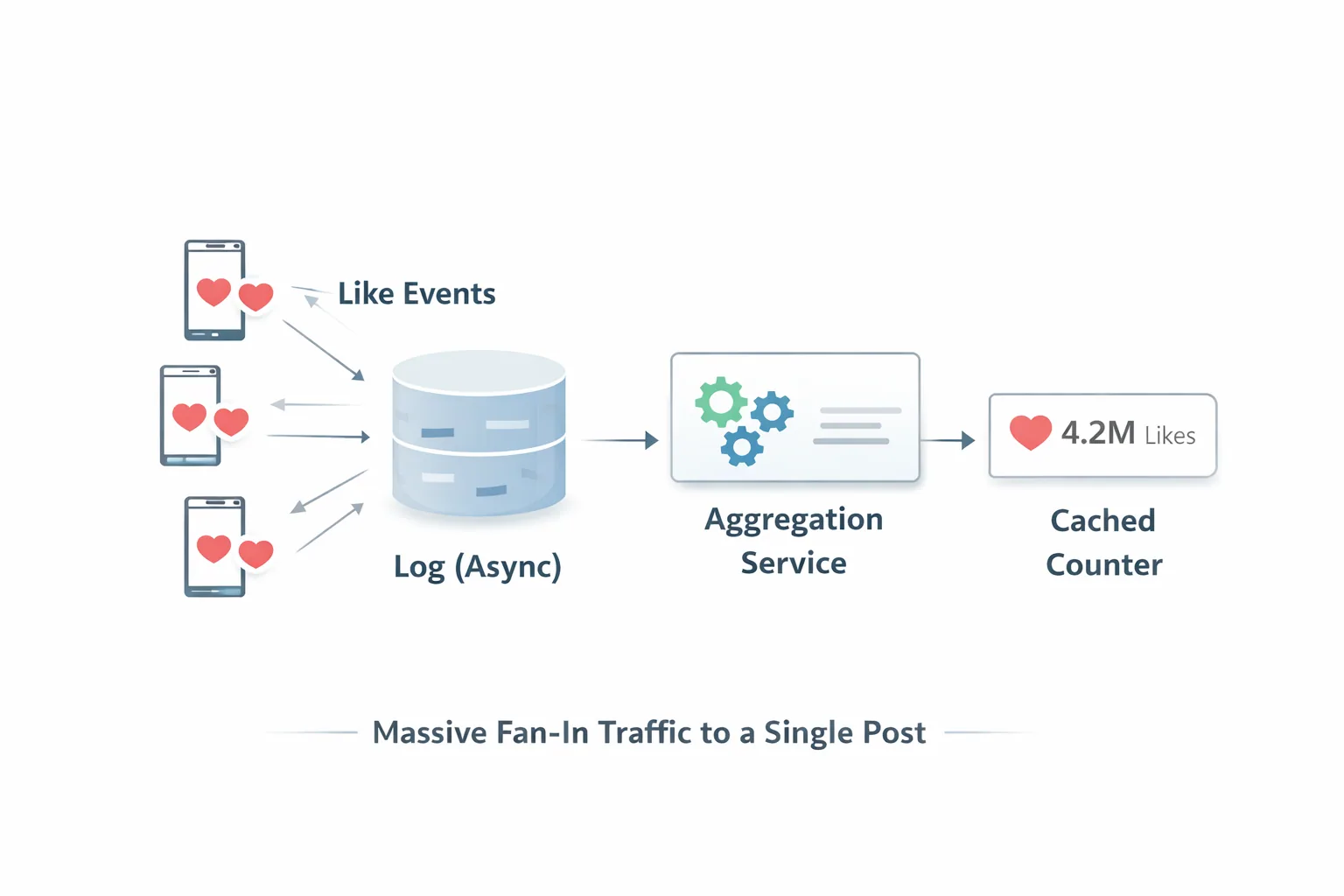
When you see “4.2M likes”, Instagram is not querying 4.2 million records.
Instead:
- likes are modeled as events, not query results
- each like action is written to write-optimized storage or logs
- the displayed number comes from cached aggregate counters
Key properties:
- counters are eventually consistent
- reads are constant-time
- writes are append-only and cheap
“4.2M likes” is a materialized view, not a live computation.
3. Comments Are Paginated and Sharded by Design#
Instagram never loads all comments for a post.
Comments are:
- partitioned by post_id
- distributed across independent shards
- fetched in bounded windows
Scrolling loads:
- 20–50 comments at a time
- already filtered and ranked
There is no API that returns “all comments”.
That endpoint does not exist.
4. Read Path and Write Path Are Fully Decoupled#
This is the most critical design decision.
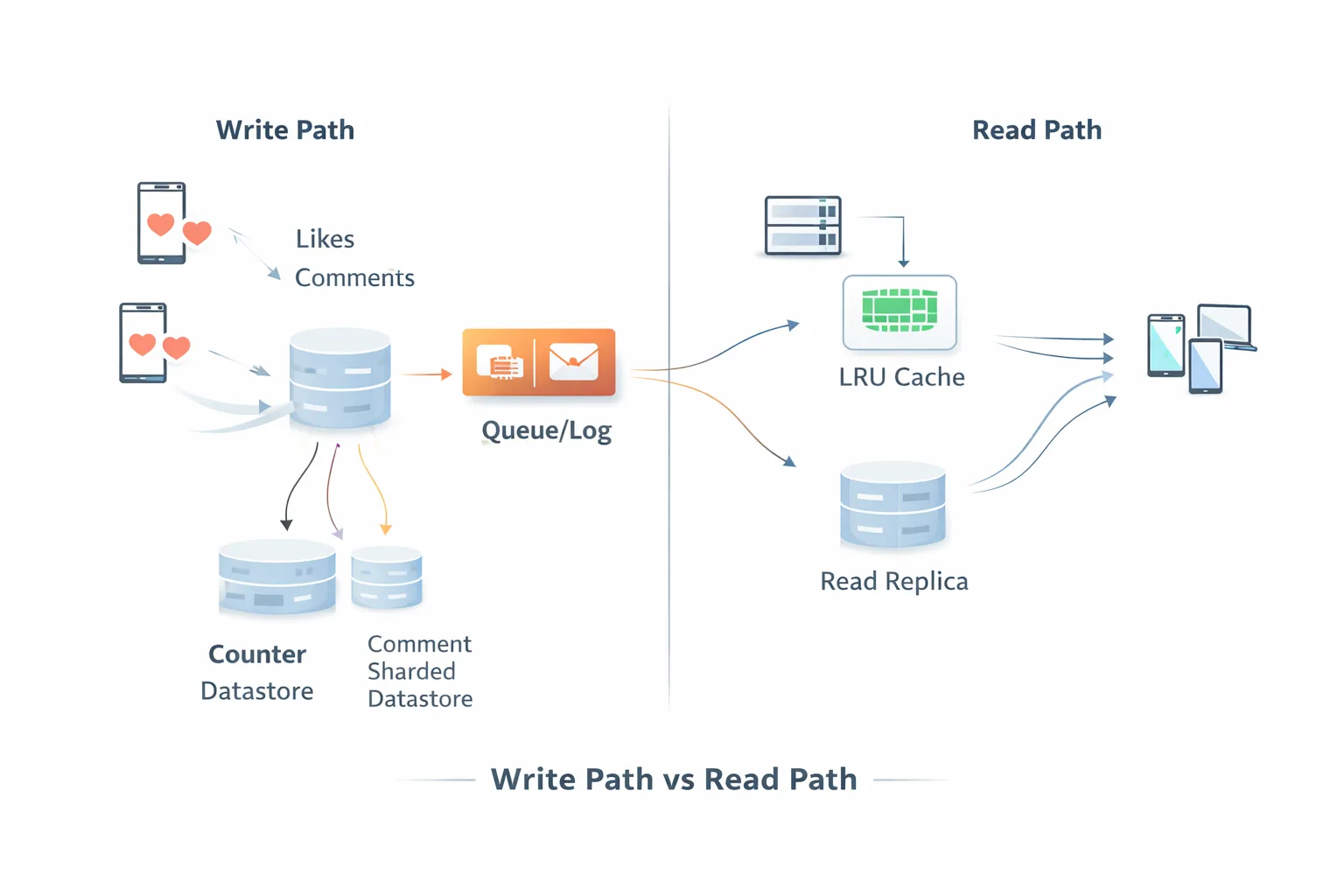
Writes (likes, comments):
- flow through queues or append-only logs
- are processed asynchronously
- never block user-facing reads
Reads:
- hit caches and read replicas
- fetch precomputed views
- never wait on writes
This separation means:
- write spikes do not affect read latency
- virality does not cascade into outages
Reads and writes scale independently.
5. Multi-Layer Caching for Hot Posts#
Once a post starts going viral, it is quickly marked as HOT.
Hot posts are served from:
- CDN caches
- edge caches
- in-memory application caches
As a result:
- most requests never reach the database
- recomputation is avoided
- traffic is absorbed at the edge
The database stays a system of record, not a traffic handler.
6. Ranking Is Precomputed, Not Sorted Live#
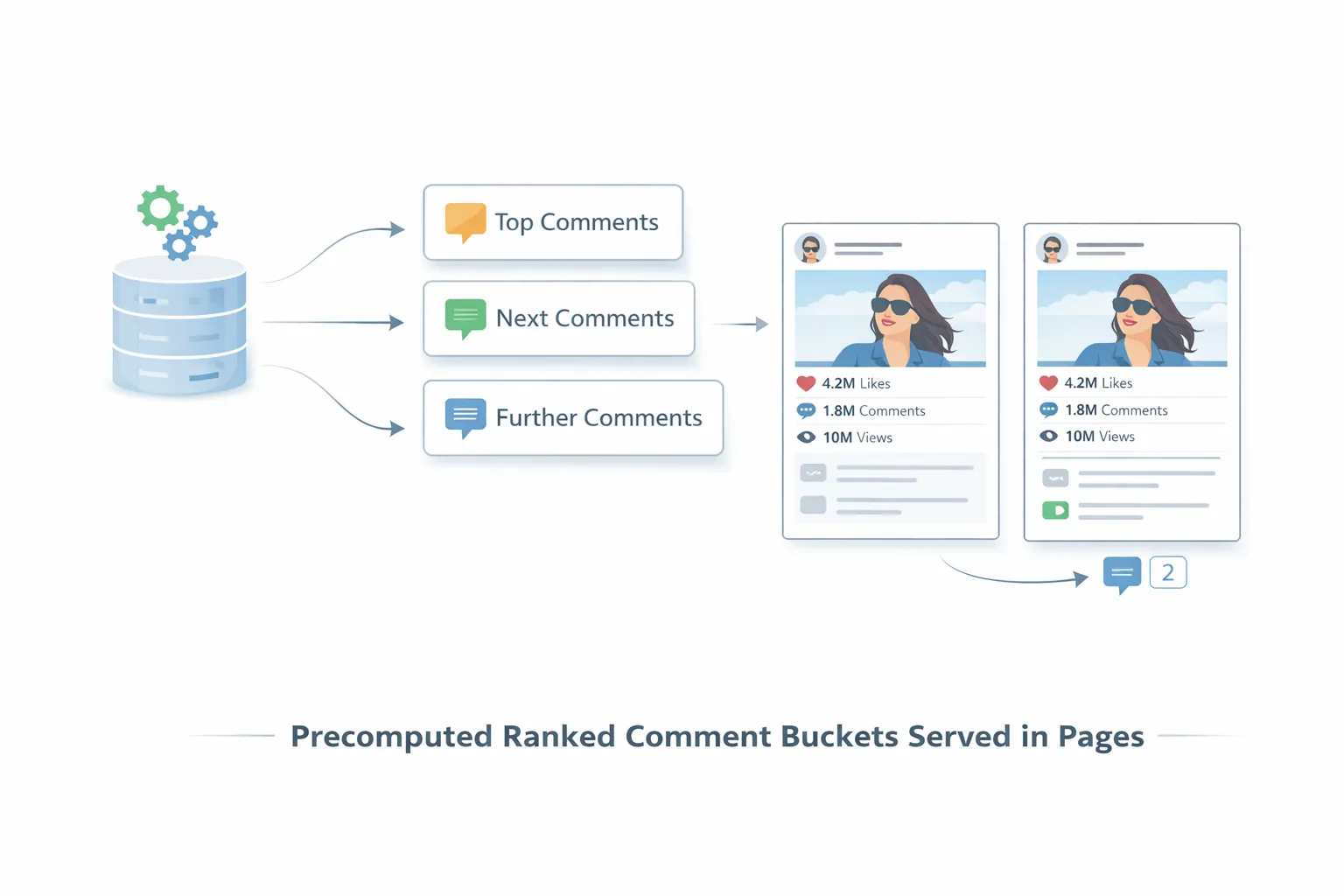
Instagram does not sort comments during user requests.
Instead:
- rankings are computed asynchronously
- “top comments” are maintained with priority queues
- updates are batched in the background
When a user scrolls:
- the backend fetches a prepared slice
- returns it directly
No live sorting. No expensive queries under load.
7. Async Fan-Out With Optimistic UI#
When you like or comment:
- the UI updates instantly
- the backend write happens asynchronously
This is optimistic execution.
The system assumes success and:
- reconciles counters later
- resolves conflicts asynchronously
This avoids:
- global locks
- hot-row contention
- user-visible latency spikes
Correctness is eventual. Responsiveness is immediate.
8. Why Instagram Never “Fully Loads” Anything#
You never load:
- all likes
- all comments
- all viewers
Everything is:
- paginated
- windowed
- eventually consistent
Unbounded operations are explicitly forbidden on the synchronous path.
This is not an optimization. It is a survival strategy.
Final Takeaway#
Instagram scales viral posts by refusing to read or write unbounded data synchronously.
Virality does not break the system because the system was designed on the assumption that virality would happen.
That is real-world system design.
Filed under hot-keys, caching, scalability

Written by Dhananjay Aggarwal