System Design Failures Are Silent: Y2K as a Case Study
Y2K broke no requirement. It came from a sound storage trade-off whose assumption quietly expired, and the same kind of assumption is in systems built today.
 Dhananjay Aggarwal, · 6 min read
In the history of computing, very few problems triggered global coordination, government intervention and billions of dollars in preventive engineering. The Y2K problem was one of them. It was not caused by faulty logic or broken code. It came from a reasonable assumption made under real constraints, one that silently became invalid over time.
Understanding Y2K is less about nostalgia and more about understanding how long-lived systems fail.
The Engineering Context of the 1960s and 1970s#
In the early decades of enterprise computing, memory was expensive and scarce. Systems ran on mainframes where every byte mattered. Storage optimization was not an academic exercise. It was a survival requirement.
Engineers made a deliberate and intelligent decision.
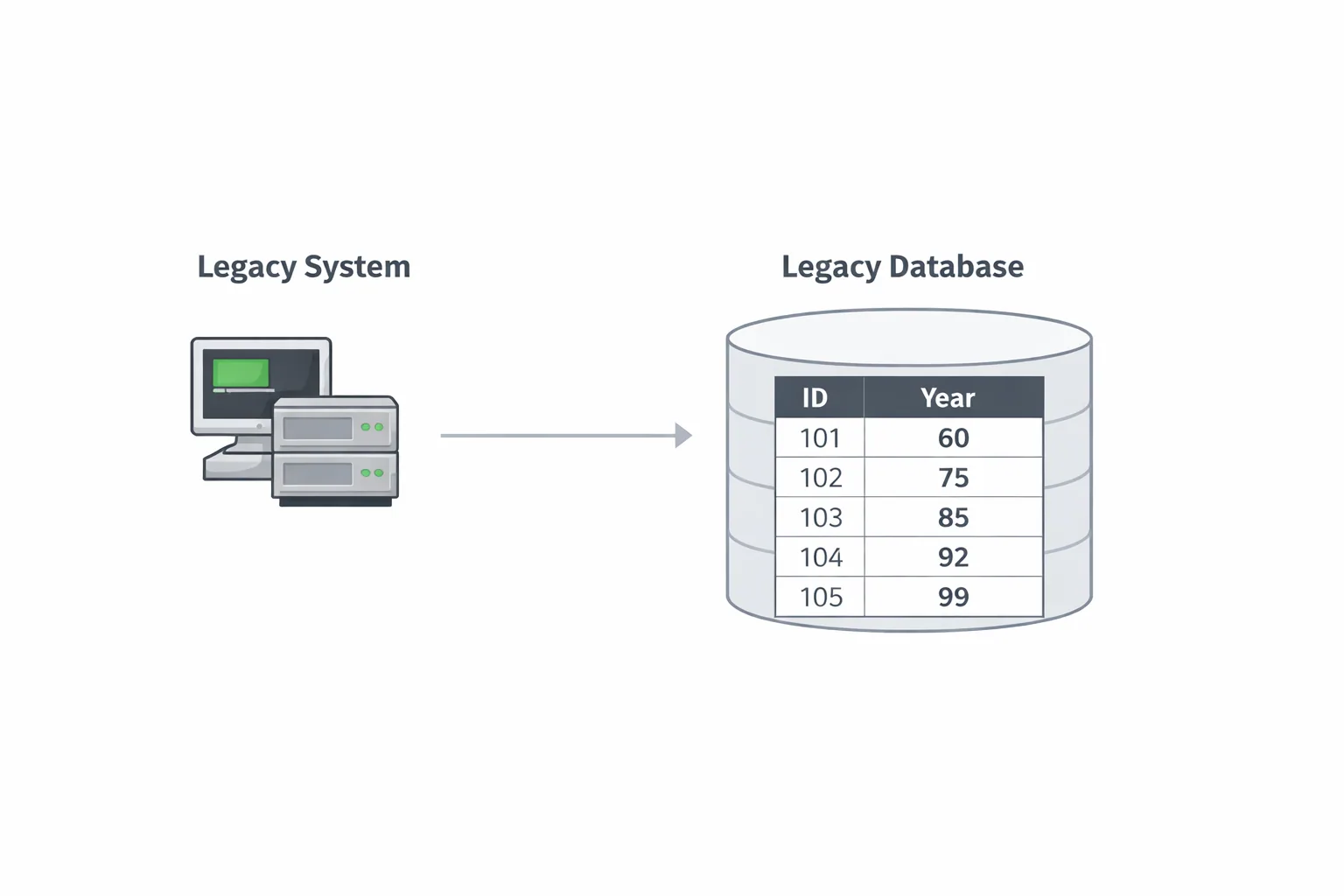
Instead of storing years as four digits, they stored only the last two.
- 1960 became 60
- 1975 became 75
- 1999 became 99
This choice cut storage requirements, improved performance and simplified data layouts across millions of records. At the time, it was a sound engineering trade-off.
No system was expected to run unchanged for decades.
The Hidden Assumption Embedded in Code#
The critical assumption was simple and implicit.
Any two-digit year belongs to the 1900s.
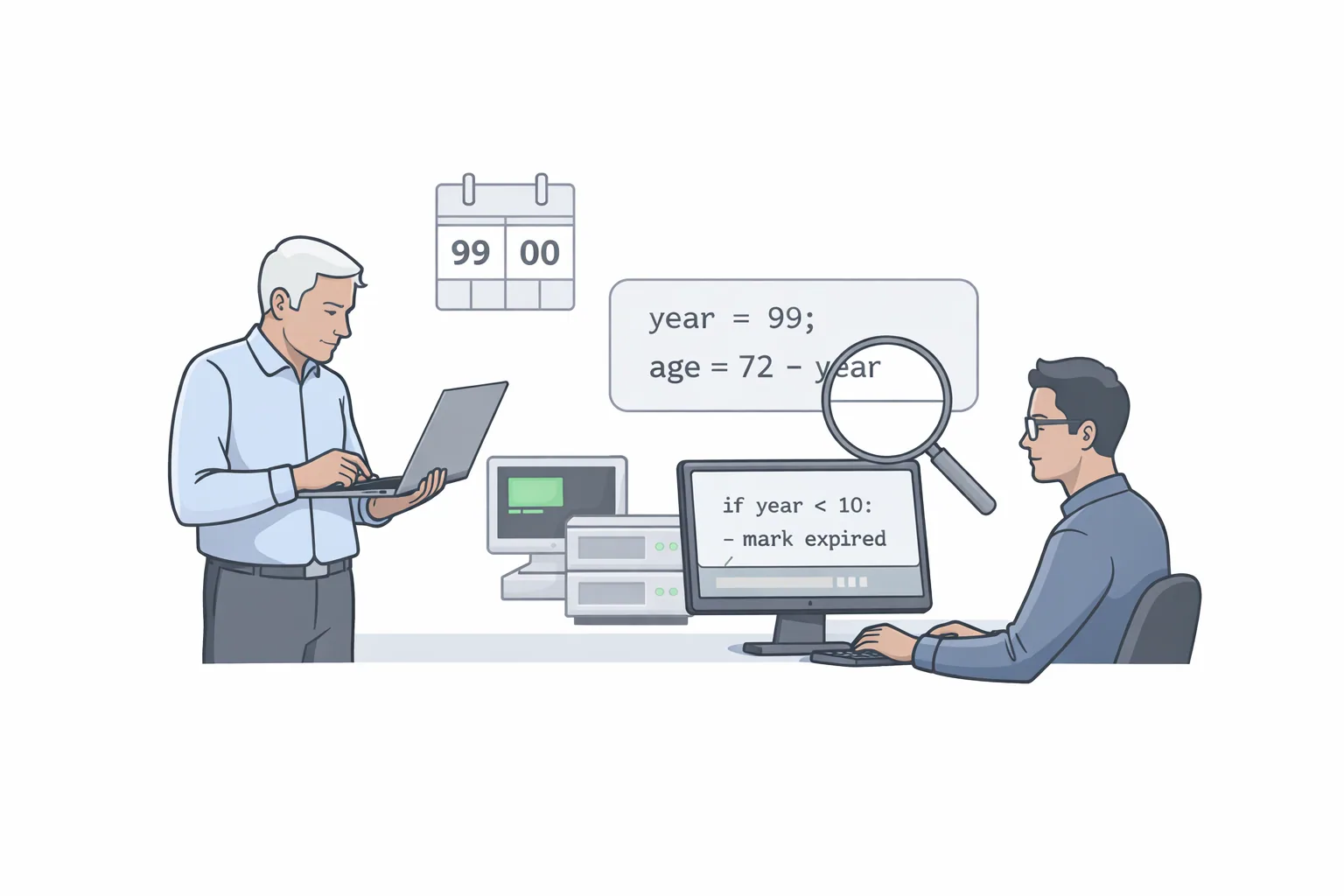
This assumption was never written down as a comment or a specification. It was embedded in business logic, date arithmetic, sorting routines, interest calculations and batch processing jobs.
For decades, the assumption held.
Then the calendar approached the year 2000.
What Actually Breaks at Year 2000#
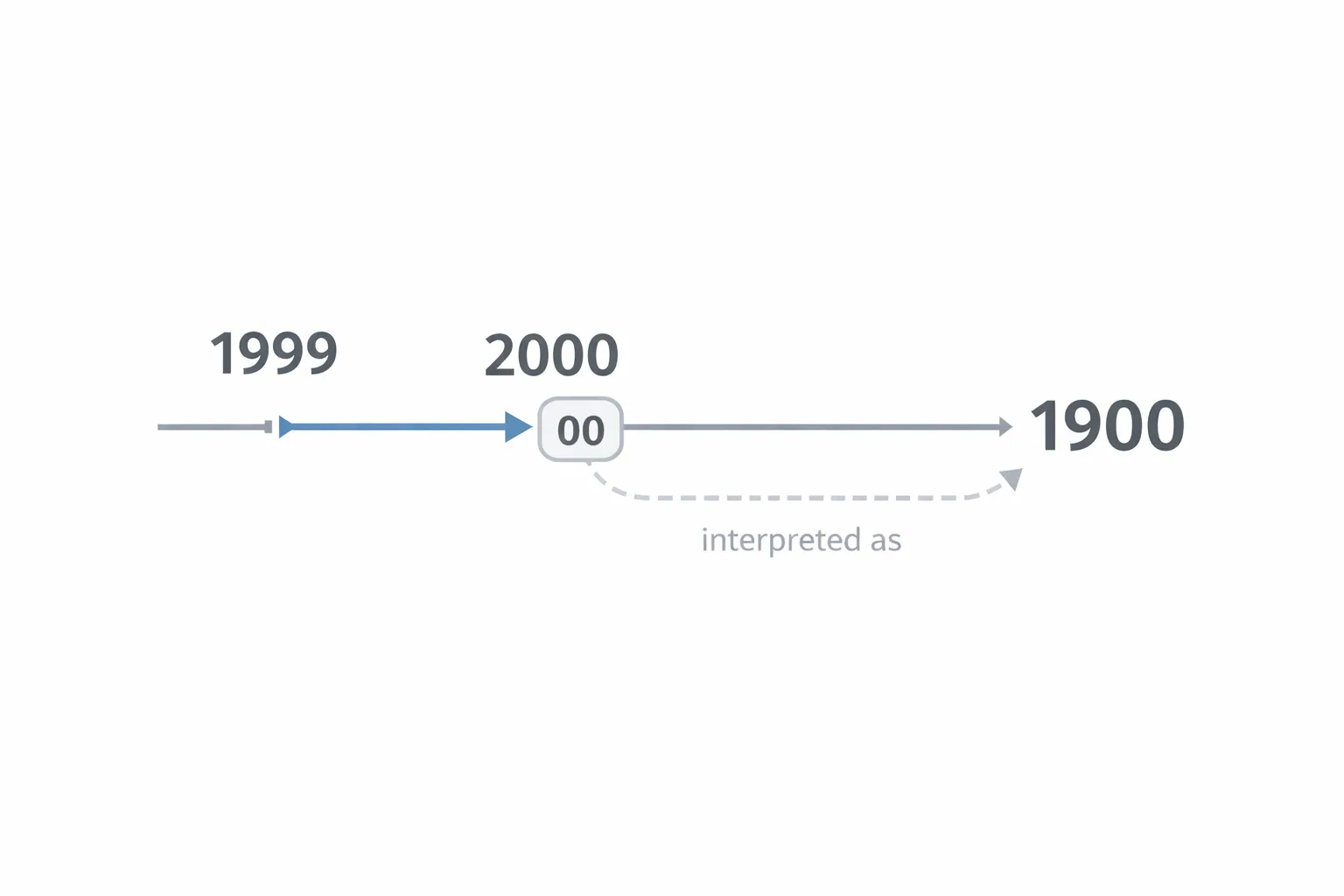
When the year rolled over from 1999 to 2000, systems did not see 2000.
They saw 00.
And 00 was read as 1900.
This caused several classes of failure:
- Date comparisons suddenly moved backward by 100 years
- Time-based ordering logic broke
- Interest calculations produced negative durations
- Age calculations turned customers into centenarians or newborns
- Expiry checks marked valid assets as expired
The danger was not cosmetic. It was systemic.
Why Banking and Finance Were at Extreme Risk#
Financial systems lean heavily on time.
- Loan amortization schedules
- Interest compounding
- Bond maturity calculations
- Credit card expiry validation
- Regulatory reporting windows
Even a small date misreading can cascade into large financial inconsistencies.
Many core banking systems were written in COBOL decades earlier and were still running critical national infrastructure. Rewriting them was not feasible. Auditing and correcting them was the only option.
The Scale of the Mitigation Effort#
Governments and enterprises around the world spent billions of dollars on Y2K remediation.
The work involved:
- Scanning millions of lines of legacy code
- Identifying date fields and assumptions
- Expanding year representations
- Adding pivot-year logic where full migration was impossible
- Testing systems under simulated future dates
The success of Y2K mitigation is often misunderstood because the disaster did not happen. That absence was the result of enormous engineering effort, not proof that the problem was exaggerated.
Why Y2K Was Not a Bug#
A bug implies incorrect implementation relative to a known requirement.
Y2K violated no requirement at the time it was written.
The systems worked exactly as designed.
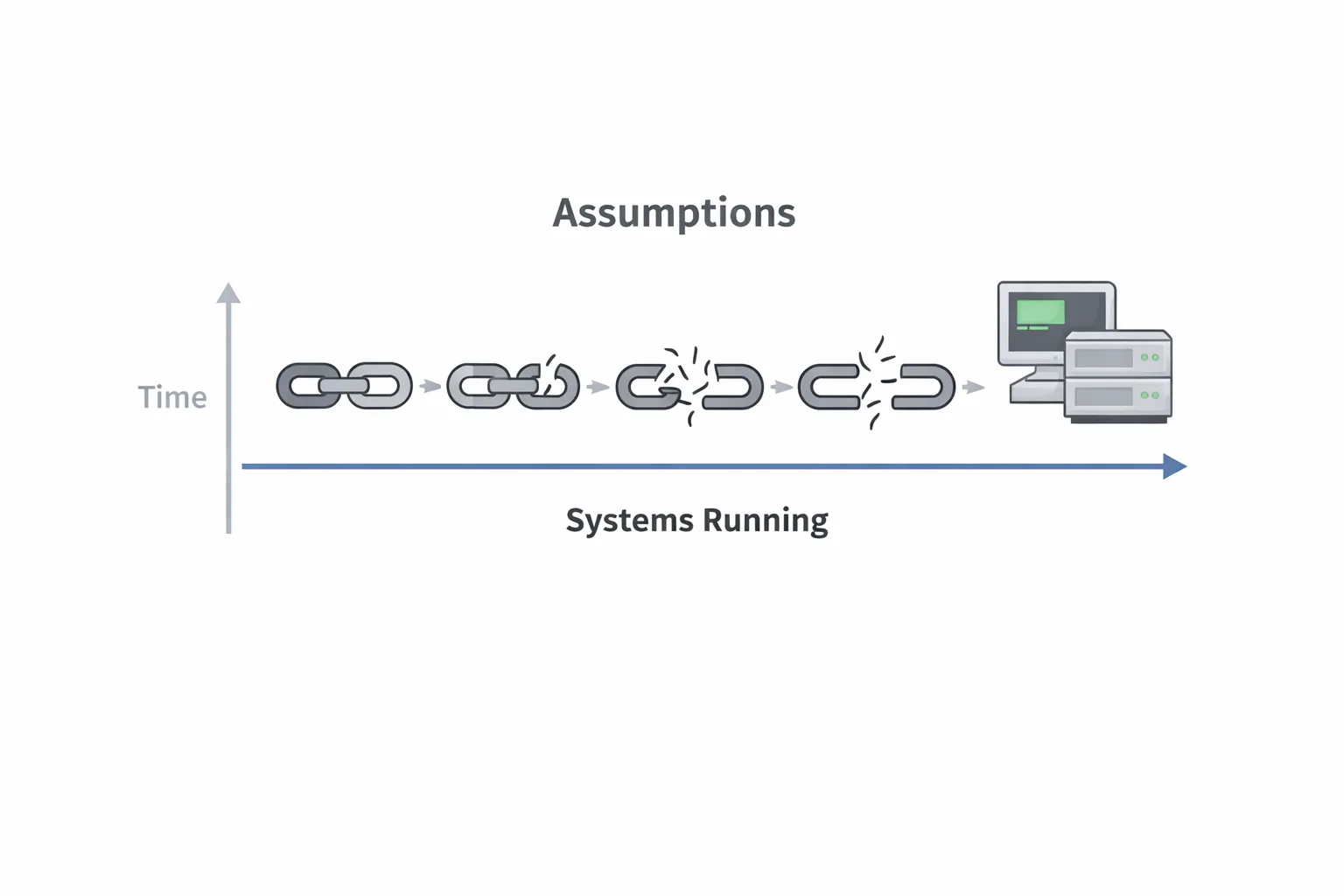
The failure happened because the original design embedded an assumption about system lifespan and temporal scope. That assumption became false as systems outlived their expected lifetime.
This distinction matters.
Most catastrophic failures in software systems are not caused by syntax errors or broken algorithms. They are caused by assumptions that quietly expire.
The Deeper Engineering Lesson#
Y2K teaches a core systems principle:
Code often lives longer than its assumptions.
Engineers today still make similar trade-offs:
- Using 32-bit timestamps
- Hardcoding regional formats
- Assuming monotonic traffic growth
- Designing schemas without versioning
- Treating configuration as static
These decisions are often correct today. They become dangerous when systems scale, persist or evolve beyond their original boundaries.
Why This Still Matters Today#
Many systems running critical infrastructure today were not designed for:
- Global scale
- Multi-decade lifespans
- Continuous deployment
- Regulatory evolution
Yet they persist.
Y2K is a reminder that engineering decisions must be documented, revisited and challenged periodically. They may not have been wrong. The world around them changes.
Final Takeaway#
The Y2K problem was not a failure of intelligence or skill.
It was a failure of foresight under constraints.
The engineers of the past optimized correctly for their reality. The problem emerged because their code succeeded far beyond its expected lifetime.
As engineers, the responsibility is not to avoid assumptions. That is impossible.
The responsibility is to know which assumptions we are making, and to design systems that can survive when those assumptions eventually break.
Filed under system-design, legacy-systems, failure-modes

Written by Dhananjay Aggarwal