How Instagram Actually Delivers a Reel to Your Feed
From a 50 MB upload to the first three seconds on your screen: HLS segmentation, CDN edges, candidate selection, prefetching and the ranking loop.
 Dhananjay Aggarwal, · 6 min read
Most users assume the Instagram feed is a linear scroll of random videos. Behind the interface there is a highly optimized streaming pipeline and a multi-stage ranking system that decides what appears on your screen within milliseconds. This article walks through that entire lifecycle, from the moment a creator uploads a Reel to the instant a viewer watches the first three seconds.
Upload to Server: What Actually Happens When a Reel Is Shared#
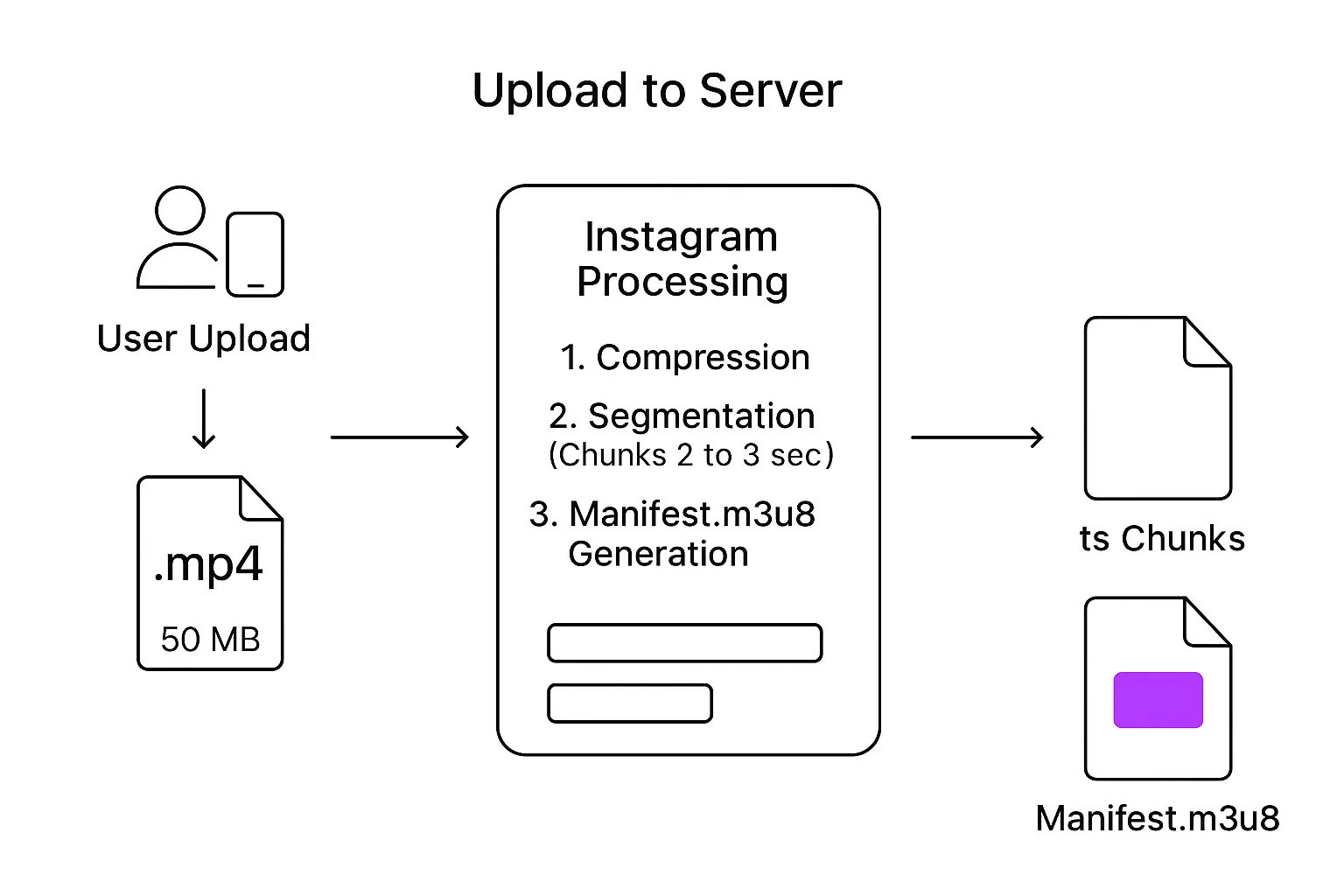
The moment a creator taps Share, the video does not move straight into the feed. Instagram runs a set of transformations to make the file streamable at scale.
1. Compression#
User-generated videos are large raw files. A 50 MB upload is immediately transcoded with codecs like H.264 or H.265. The goal is to reduce bandwidth consumption and prepare multiple bitrate variants for adaptive streaming.
2. Segmentation#
After compression, the video is cut into smaller chunks. Each chunk typically spans two to three seconds. This is part of HLS, which stands for HTTP Live Streaming. Instead of streaming one long file, the platform streams short transport stream segments that can be preloaded and cached efficiently.
3. Manifest File Creation#
HLS needs a manifest file, also known as an M3U8 playlist. This file does not contain video data. It lists the sequence and location of the segments so the video player can request them in order.
A simplified example looks like:
This structure makes fast seeking and adaptive bitrate switching possible.
CDN Distribution: Why Segments Are Placed Near You#
After processing, Instagram distributes the chunks across a global CDN with edge servers in different geographies. A viewer in Delhi should not fetch video segments from a data center in California. Latency would be unacceptable and the first few seconds of playback would stutter.
CDNs store copies of the segments on regional servers. When the app requests a chunk, the nearest edge node responds. This is why Reels often load instantly even on average mobile networks.
Candidate Selection: How Instagram Chooses Who Should See the Video#
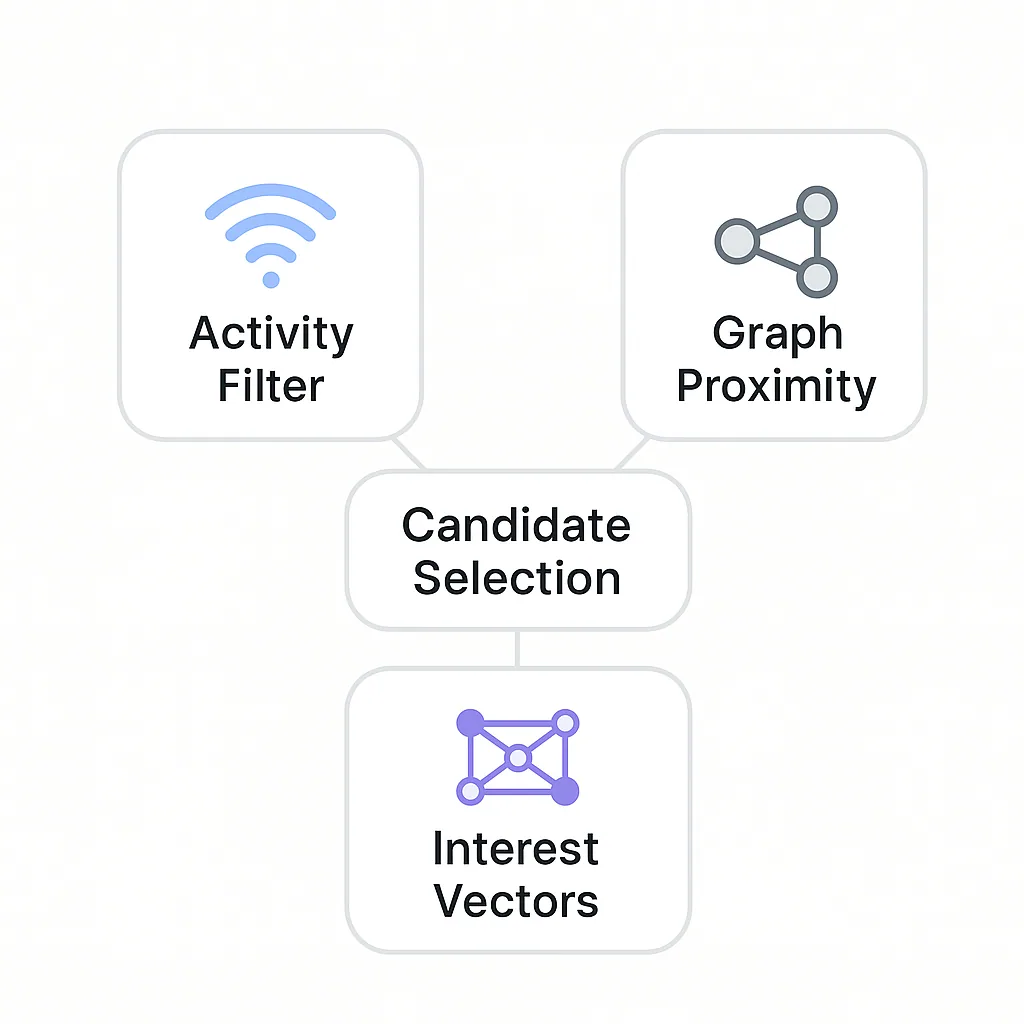
Before any ranking logic runs, Instagram has to identify a subset of users who are eligible to see the new Reel.
1. Activity Filter#
The system identifies users who are online now or were active within the last few minutes. Cold candidates are deprioritized to conserve resources.
2. Interest Vectors#
Each user has an embedding that represents their content consumption pattern, for example Tech, Gaming, Music or Fashion. These high-dimensional vectors let the system estimate relevance scores efficiently.
3. Graph Proximity#
Follower relationships provide strong ranking signals. A user who follows the creator gets a higher probability weight in candidate selection. If the follower graph is weak, the system falls back to interest-based similarity.
This first stage narrows the user pool significantly before the more expensive ranking computations start.
The Three-Second Prefetch Rule: How Playback Starts Instantly#
Instagram fetches only the first two- or three-second chunk of a Reel before it reaches your viewport. This is known as prefetching. The player does not download the entire video right away. It only prepares the initial segment so playback feels instantaneous.
This approach reduces wasted bandwidth. If a user scrolls past the Reel without stopping, the app avoids downloading the rest of the file. If the user pauses or watches for longer than two to three seconds, the player starts fetching the remaining segments.
YouTube, Netflix and TikTok use the same technique. It is a practical example of latency hiding, where the system does work just before it is needed.
Real-World Confirmation: The Offline Playback Phenomenon#
You may have noticed that the first second of a Reel plays even after the network is turned off. This is a direct consequence of prefetching. Instagram keeps a short buffer of the next few videos in your feed. When you scroll into them, the prefetched chunks are available locally, and playback begins instantly until the buffer runs out.
This buffer generally holds only the first chunk. The full video downloads only after the viewer engages with the content.
Ranking and Expansion: How a Reel Becomes Viral#
Once the system sees that some users watched the full Reel or interacted with it, the ranking score goes up. These interactions help train collaborative filtering models, which identify similar audience groups.
Key signals include:
- Watch duration
- Likes
- Shares
- Comment frequency
- Rewatch behavior
High-performing Reels first expand to a creator’s follower base, then to non-followers who share similar interaction patterns. Over time the distribution widens as the model gains confidence that the video is engaging across demographic clusters.
Conclusion: Behind the Scroll Is a Highly Engineered Pipeline#
Reels feel effortless to watch, but the underlying architecture is extremely sophisticated. Instagram combines HLS-based video delivery, global CDN caching, multi-stage recommendation pipelines and real-time interaction feedback to decide what appears in your feed. Every swipe triggers ranking recalculations, and every view feeds the collaborative filtering loop that shapes future recommendations.
Understanding this architecture is valuable for engineers building scalable media platforms, and for creators who want to optimize content for better reach.
Filed under video-streaming, cdn, recommendation-systems

Written by Dhananjay Aggarwal