Claude Opus 4.8 Is Not Just a Benchmark Win. It Changes How You Build With AI
What shipped with Opus 4.8 on May 28, 2026: the honesty gains, Dynamic Workflows, effort control and cheaper fast mode, and who should migrate.
 Dhananjay Aggarwal, · 13 min read
I have been building AI-powered products for a while now, and I will be honest with you: every new model drop used to feel like a rerun. Better score on benchmark X, slightly worse on Y, same price, same song. Claude Opus 4.8, which Anthropic shipped on May 28, 2026, feels different. The numbers did jump, but what stands out is what improved: honesty, judgment, and the ability to run longer without you babysitting it. These are the traits that actually move the needle in production.
So let me break down everything that shipped, what the numbers mean, and more importantly, what you should actually do with it.
What Shipped on May 28, 2026#
Anthropic released three things in a single day, and all three matter:
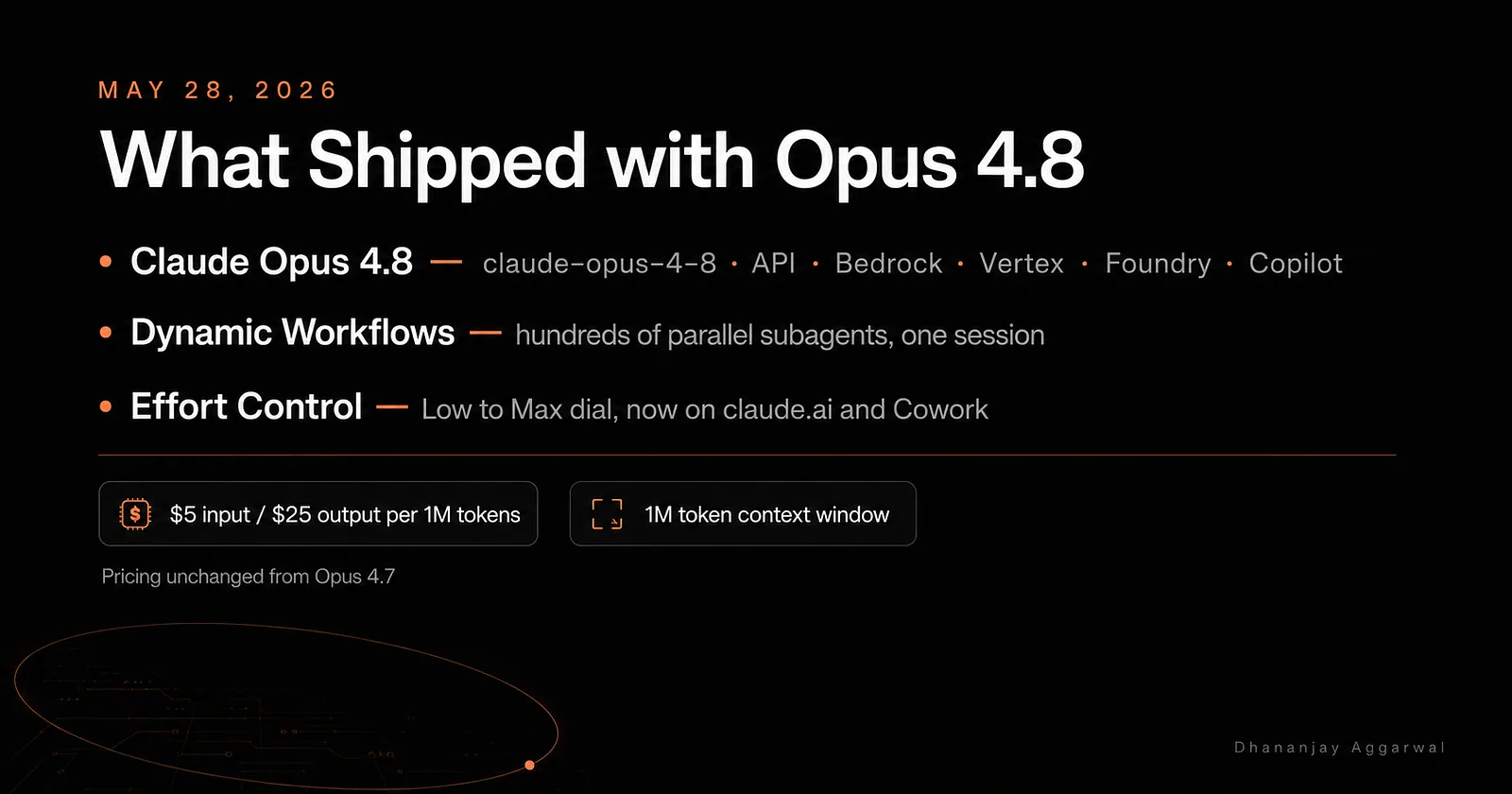
- Claude Opus 4.8 (API model ID: claude-opus-4-8): available immediately on the Claude API, Claude.ai, Amazon Bedrock, Google Cloud Vertex AI, Microsoft Foundry and GitHub Copilot.
- Dynamic Workflows inside Claude Code: a research preview that lets one session orchestrate hundreds of parallel subagents for large-scale work.
- Effort Control UI on claude.ai and Cowork: a visible dial from Low to Max that puts compute decisions in your hands.
Pricing did not move. The standard rate is $5 input / $25 output per million tokens, identical to Opus 4.7. The context window stays at 1M tokens on the API, Bedrock and Vertex AI.
The Benchmark Picture: An Honest Read#
Here is the full competitive matrix from Anthropic’s release:
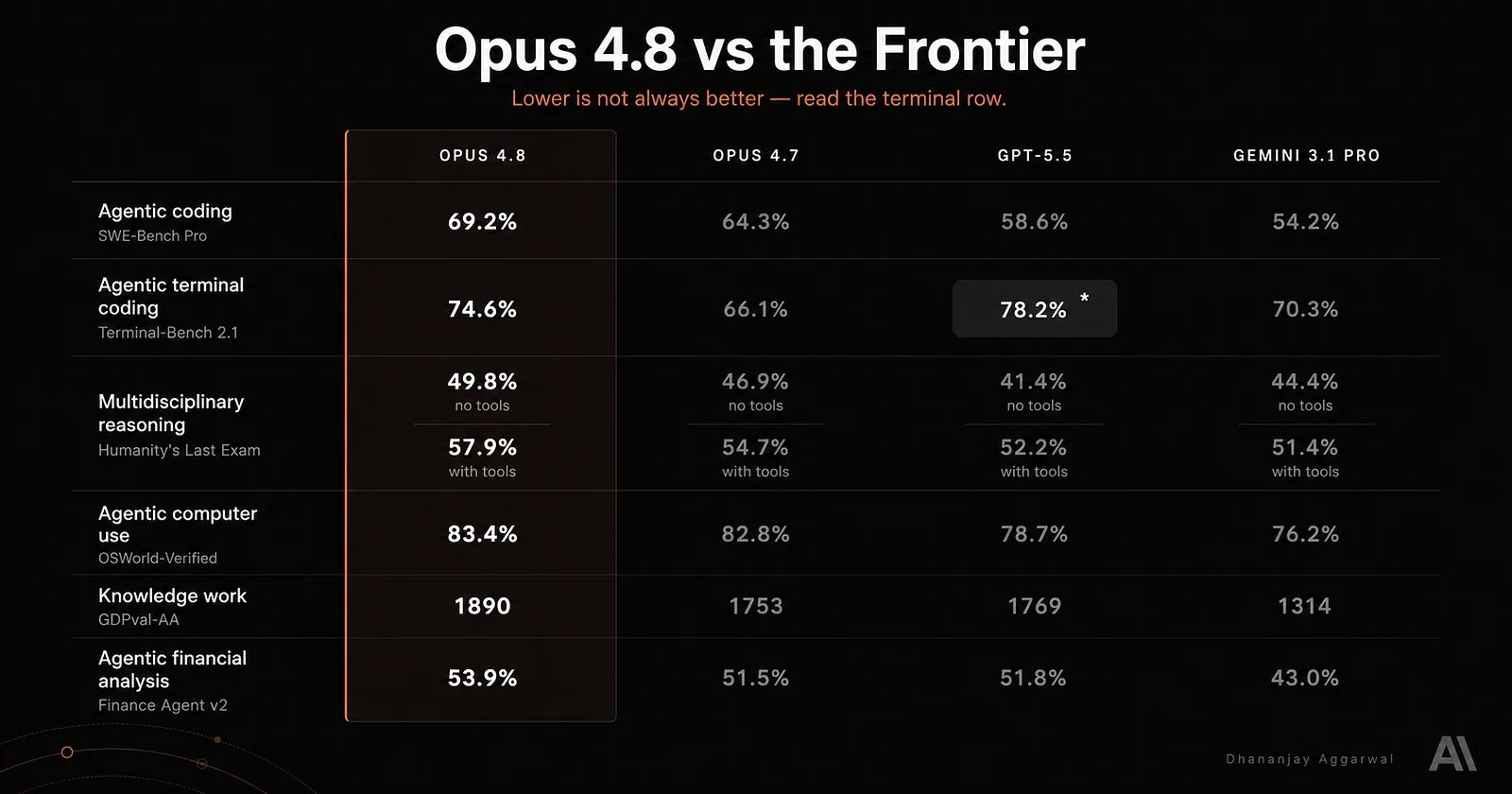
A few things stand out when I read this:
Where Opus 4.8 clearly leads: SWE-bench Pro at 69.2% is a +4.9 point jump over Opus 4.7 and a 10.6 point lead over GPT-5.5. On GDPval-AA, a 1890 Elo score puts it 121 points ahead of GPT-5.5, which implies roughly a 67% head-to-head win rate on broad knowledge-work tasks. And the USAMO 2026 math jump from 69.3% to 96.7% in a single cycle is the largest single-generation math gain I have seen from the Opus line.
Where Opus 4.8 still trails: Terminal-Bench 2.1. GPT-5.5 sits at 78.2% against Opus 4.8’s 74.6%. If your primary use case is a single autonomous agent hammering a shell, OpenAI’s model is still more competitive on this specific axis. Know that before you migrate.
The caveat the benchmarks hide: Opus 4.8 uses approximately 30% more turns than GPT-5.5 to complete equivalent tasks. Higher output quality comes with a real inference cost overhead, and that overhead adds up at scale.
The Honesty Shift: This Is the One That Compounds#
I want to spend real time on this because I think the community undervalues it.
Opus 4.8 is approximately four times less likely than Opus 4.7 to let a flaw in its own generated code pass without flagging it. According to Anthropic’s system card, it is also the first Claude model to score 0% on uncritically reporting flawed results. It fails to surface important events to the user only 3.7% of the time and shows more than a ten-fold reduction in overconfidence compared to 4.7.
Think about what that means in practice. In agentic coding, the model now asks clarifying questions before it builds the wrong thing. It surfaces its own uncertainty instead of bluffing through it. The misaligned behavior scores tell the same story:
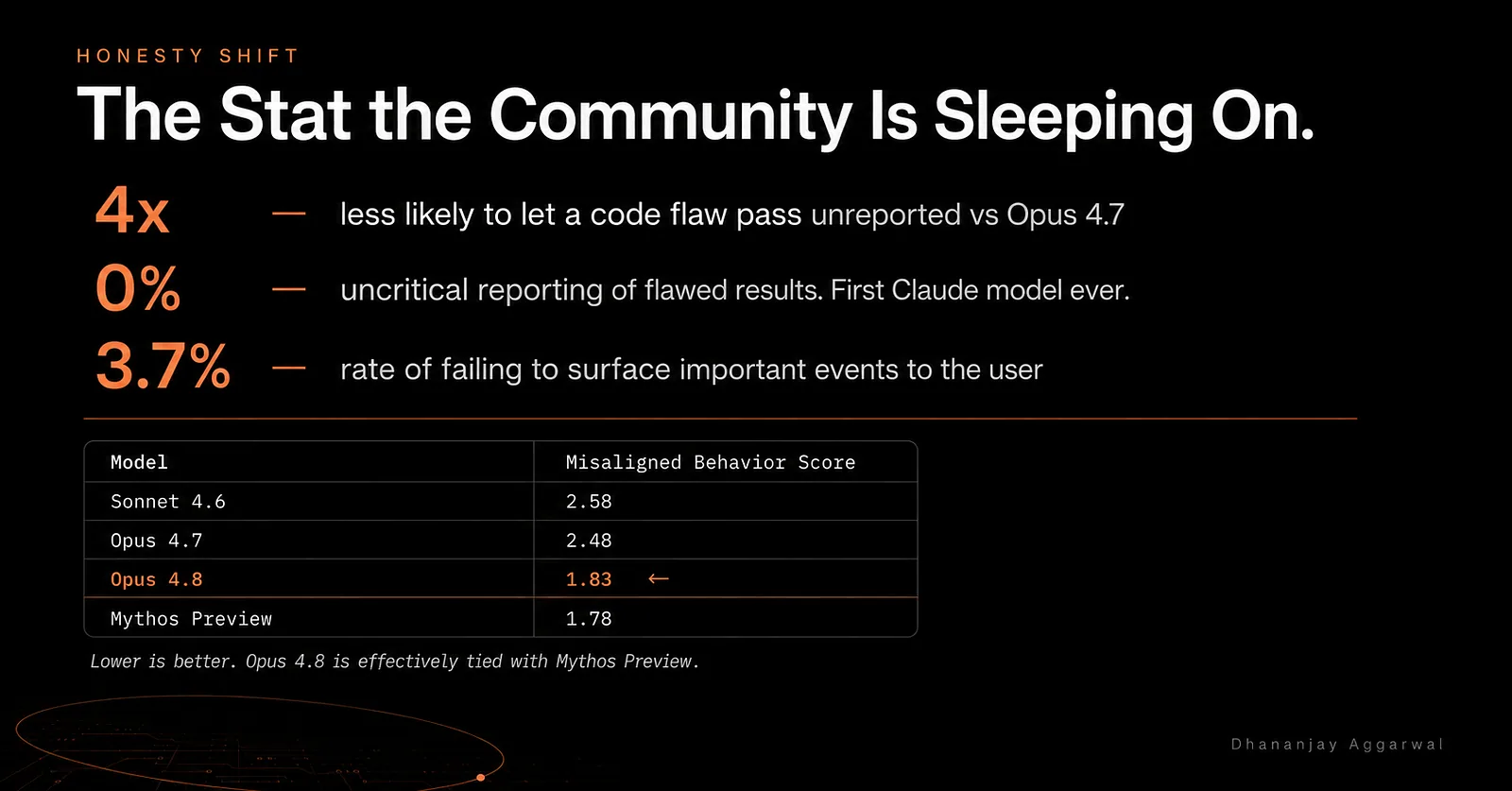
Misaligned behavior score by model (lower is better, scale 1–10)#
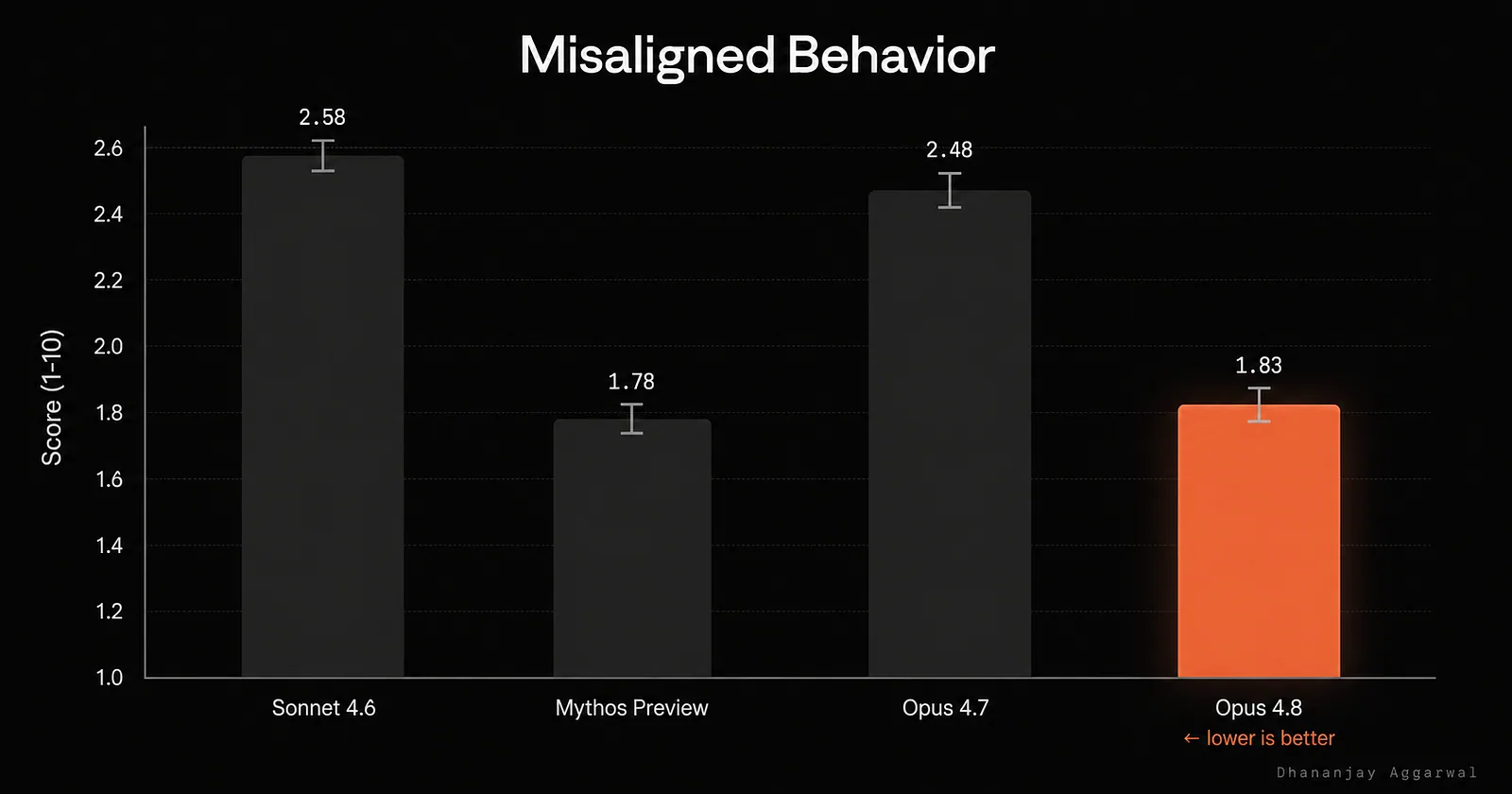
Opus 4.8 is effectively tied on alignment with Mythos Preview, Anthropic’s best-aligned model, while being available to everyone on paid plans today.
In long agentic runs, trust compounds. One unreported flaw in step 3 produces three cleanup tasks in step 7. A model that flags its own uncertainty early saves you the whole downstream cascade. This is not a benchmark footnote. For teams doing agentic code review, this is a production reliability change.
Dynamic Workflows: Claude as the Orchestrator, Not Just the Worker#
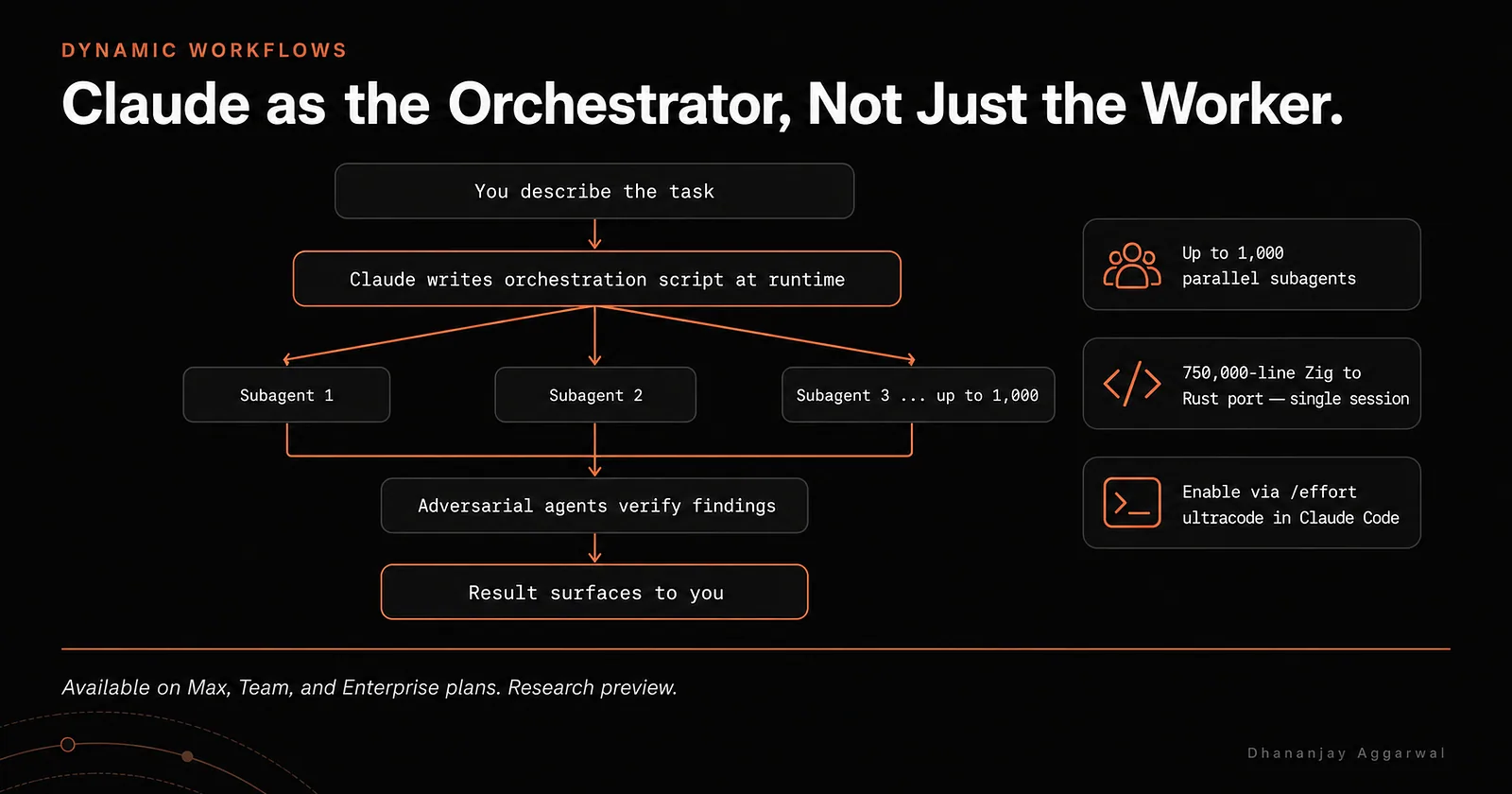
This is the highest-leverage new capability for engineering teams, and it shipped as a research preview inside Claude Code on the same day.
Before Dynamic Workflows, if you wanted multi-agent parallelism you had to design it yourself. You decided how many agents to spawn, what each one would do, and how they would coordinate. Claude executed your plan.
Dynamic Workflows inverts this completely. You describe what you want. Claude writes the orchestration script at runtime: it decides how to break the task apart, how many subagents to spin up (up to 1,000 per run), what each one investigates, and when the answers are good enough to report back. Adversarial agents try to refute findings before anything surfaces to you.
The practical ceiling this unlocks: Anthropic published a real-world case of a 750,000-line Zig-to-Rust port handled in a single session. Klarna used it for codebase-scale dead code discovery. Repository-wide migrations that used to mean breaking work into files one at a time now run end to end, kickoff to merge.
How to enable it: Dynamic Workflows is available on Max, Team and Enterprise plans. Enterprise requires admin enablement; Max and Team have it on by default. In Claude Code, enable it with /effort ultracode. Ultracode is not a new API effort level. It is a Claude Code session setting that combines xhigh effort with automatic workflow orchestration.
One real constraint to know: a run can spawn up to 1,000 agents. Costs climb fast at that ceiling, especially if you run Opus 4.8 as both orchestrator and worker. The economics make sense when a workflow replaces several engineer-days, less so for casual refactors. Start with Sonnet 4.5 or Haiku for subagents and keep Opus 4.8 as the orchestrator only.
Effort Control: Finally, a Knob You Can Actually Turn#
For the first time, the effort dial is not buried in an API parameter. It is in the claude.ai sidebar, visible to every user on a paid plan.
The five levels and what they actually do:
| Level | When to use it |
|---|---|
| Low | Bulk summarization, trivial tasks, anything where speed beats depth |
| Medium | Routine drafting, summaries, everyday Q&A where you want solid but not slow |
| High (default on 4.8) | Complex reasoning, difficult coding problems, nuanced analysis |
| xHigh / Extra | Advanced agentic work, long tool-calling loops, multi-step exploration |
| Max | Absolute ceiling: no token constraints, deepest reasoning, reserve for critical decisions |
A few things to note:
Opus 4.8 defaults to High, not xHigh. That is a change from Opus 4.7, which defaulted to xHigh. On the API, Anthropic recommends starting at xHigh for agentic and coding tasks and setting max_tokens to at least 64k to give the model room to think and act across subagents. Drop to Medium or Low only after your evals confirm the lower level holds quality on your specific tasks.
Effort is a behavioral signal, not just a token cap. Lower effort means fewer tool calls, terser responses and faster turnaround. Higher effort means deeper analysis, more file reads and more exploration before acting. Running Low on simple tasks and xHigh on the hard ones is the discipline that cuts your monthly bill meaningfully without touching output quality where it actually matters.
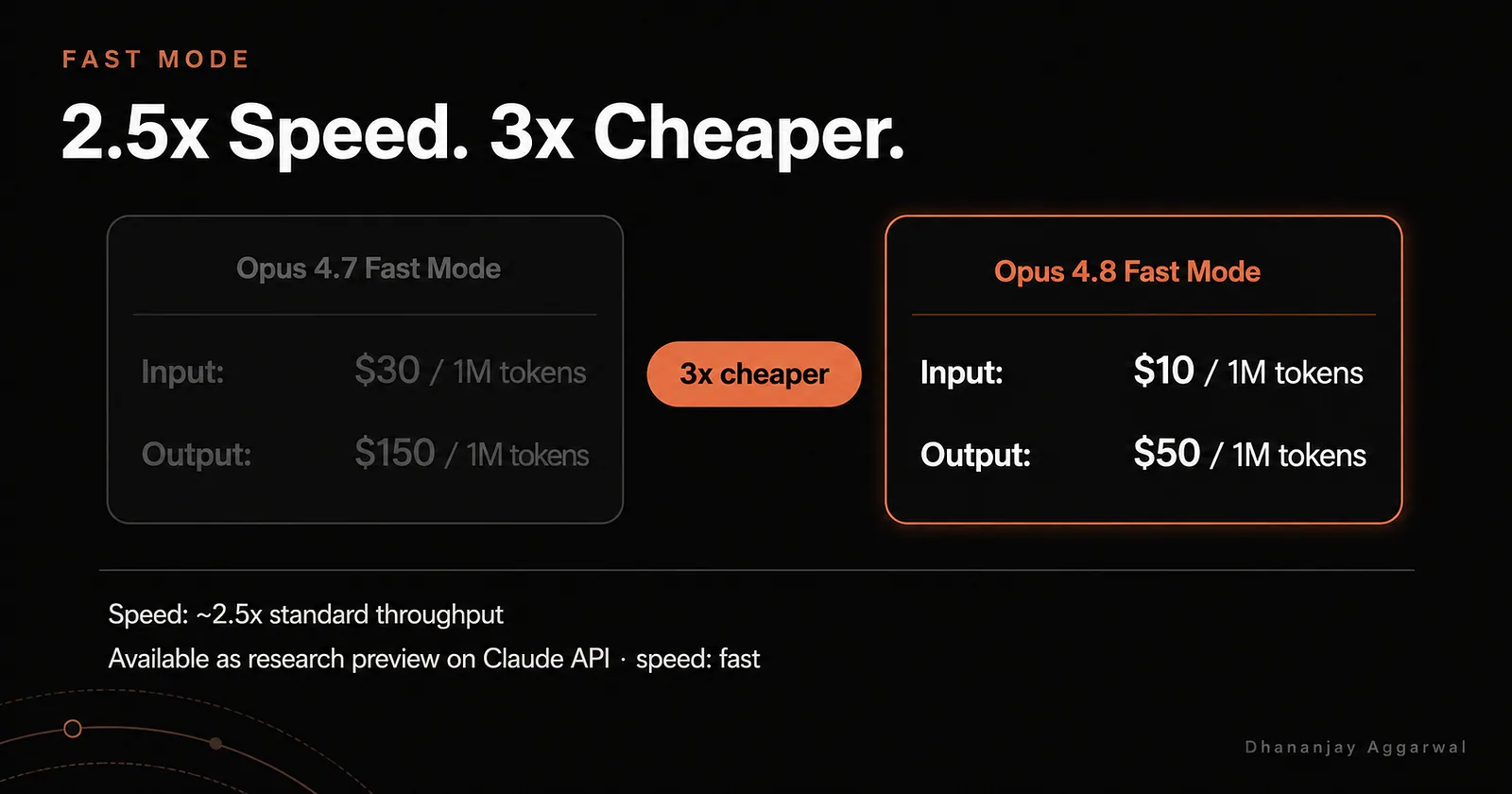
Fast Mode: 2.5x Speed, 3x Cheaper#
Fast mode is available as a research preview on the Claude API. Setting speed: "fast" pushes throughput to approximately 2.5x standard. The pricing is $10 input / $50 output per million tokens.
That looks more expensive than standard until you compare it to what fast mode cost on Opus 4.7: $30 input / $150 output.
Anthropic cut the fast tier by 3x. For conversational loops, quick responses you reach for repeatedly across a workday, and any non-critical generation task, this pricing makes real latency improvements economically viable at scale.
Mid-Conversation System Messages: The Quiet API Change#
This one will not make headlines, but it will change how you structure complex agents.
Opus 4.8 supports system entries inside the messages array, not just at the top of the conversation:
This means you can update the model’s operating rules mid-task without restarting the session. For long agentic runs where context or constraints evolve (a common real-world scenario), this is a meaningful quality-of-life improvement that also enables cleaner orchestration patterns.
The Market Response: Performance vs. Trust#
I want to be honest here, because the reaction to Opus 4.8 has been more complicated than the benchmarks suggest.
Users are raising real concerns about higher token usage per task, which translates directly into higher costs at scale. Benchmarks are not fully trusted as proxies for production reliability. And there is a strong emotional pull in the community toward Opus 4.6: an older, predictable, well-understood model that teams have already tuned their pipelines around.
This matters more than the release notes suggest. We are entering a phase in AI development where raw benchmark performance is decoupling from user satisfaction. Cost efficiency is becoming a primary evaluation criterion, not a secondary one. Reliability and consistency over long sessions are valued more highly than peak scores on short evaluations.
The models that win the next 12 months will not just be the most capable. They will be the most predictable, the most cost-transparent, and the most usable by teams that cannot afford to babysit every run.
Who Should Migrate and How#
Migrate now if:
- You run agentic coding pipelines that currently need significant post-run cleanup
- You are doing codebase-scale work (migrations, refactors, audits) where Dynamic Workflows can replace multi-day engineering effort
- You are already on Opus 4.7 and want better honesty and alignment without a price change
Migration path: for existing Opus 4.7 users, this is a one-line model swap: claude-opus-4-7 → claude-opus-4-8. No API-breaking changes. Same context window, same tool surface, same rate card.
Hold if:
- Your primary use case is single-agent terminal work, where GPT-5.5 still leads on Terminal-Bench 2.1
- You are optimizing purely for cost per task and have already tuned pipelines for a cheaper model tier
Where This Sits in the Bigger Picture#
Anthropic shipped Opus 4.8 just 41 days after Opus 4.7, its fastest release cadence yet. The positioning is explicit: Opus 4.8 is the bridge between the Claude 4.5 family and the Mythos generation. Claude Mythos Preview is already in limited access with a small number of organizations for cybersecurity work under Project Glasswing. Anthropic says a broader Mythos release is coming in the next few weeks.
For now, Opus 4.8 is the publicly accessible frontier. It is the most aligned Opus yet, the most honest, and the best equipped for long-horizon agentic work. The pricing staying flat while the capability ceiling moved up is the commercial headline to pay attention to.
The question is not whether this model is better. It clearly is. The question every engineering team needs to answer is: which of these improvements changes the economics of what you are building?
For me, the honesty shift and Dynamic Workflows are the two that change the math. Everything else is a welcome improvement. These two are architectural.
Have you shipped anything yet on Opus 4.8, or tried Dynamic Workflows on a real codebase migration?
Filed under claude, llm, ai

Written by Dhananjay Aggarwal